
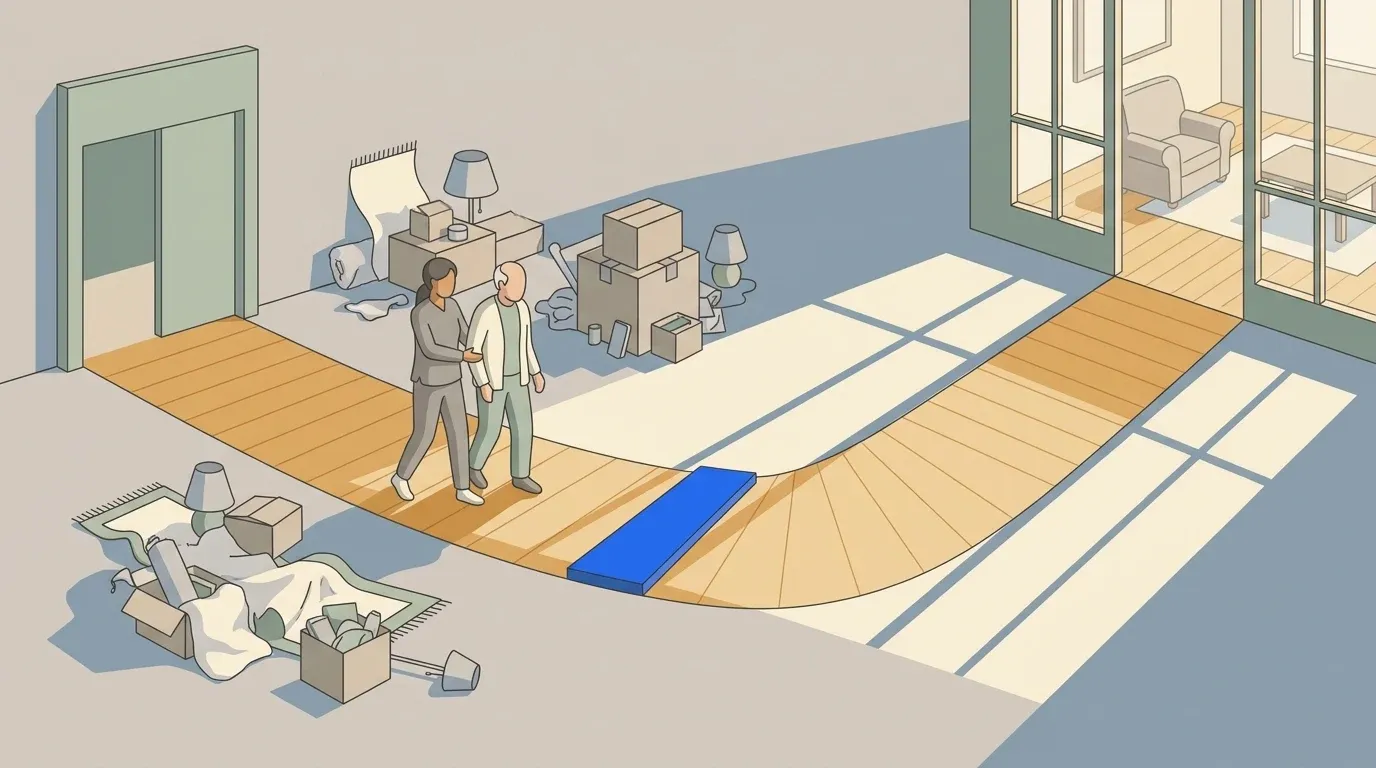
To prevent hospital readmission after a parent comes home, families need a clear discharge plan, careful medication checks, and a daily way to catch warning signs early. That means confirming medicines match the discharge orders, watching specific warning signs, keeping every follow-up appointment, and checking in daily so small changes surface before they become emergencies.
Why the First Weeks Home Are the Highest-Risk Period
The days right after discharge are when small problems tend to snowball. A missed medication dose, a wound that looks a little off, or new confusion can escalate quickly in someone who just left the hospital, especially before the body has had time to fully stabilize outside a clinical setting. Older adults recovering from an inpatient stay are also at elevated risk for delirium, and the National Institute on Aging notes that delirium complications can include emergency visits and readmission within 30 days after discharge. Researchers point to the Hospital Elder Life Program, developed by Dr. Sharon Inouye, as one structured approach shown to reduce delirium incidence by 40% in hospitalized older adults, which shows how much early attention and orientation matters even after your parent leaves the hospital building. That single fact should shape how a family plans the first month: less about grand gestures, more about a steady rhythm of checking in and catching changes early.
Sibling teams often split up around this period, with one adult child handling medical logistics and another handling the emotional side. If you are dividing responsibilities this way, how siblings can share post-hospital care covers how to divide tasks without duplicating effort or dropping something important.
How to Prevent Hospital Readmission With a Clear Discharge Plan
To prevent hospital readmission, build a real discharge plan before your parent leaves the building, confirm every medication change in writing, know the specific warning signs to watch for, and set up daily contact during recovery so problems surface while they are still small and manageable at home. The Agency for Healthcare Research and Quality identifies five discharge topics every family should nail down: life at home, medicines, warning signs, test results, and follow-up appointments.
Ask the discharge team to walk through each of these five areas out loud, and use teach-back, a method AHRQ recommends, where your parent or you repeat instructions back in your own words to confirm real understanding rather than polite nodding. If you have not already built a home safety plan, the checklist for bringing an elderly parent home from the hospital walks through exactly what to prepare before the car ride home.
Medication Errors Are a Leading Preventable Cause
Medication mix-ups are one of the most common and most preventable reasons someone ends up back in the hospital. Prescriptions often change during a hospital stay, and old bottles from before admission can get mixed in with new ones at home. The Centers for Medicare and Medicaid Services reported a 74.0% national average for Medicare Advantage enrollees whose medicines were reconciled within 30 days of inpatient discharge, which means roughly a quarter of patients did not get that reconciliation confirmed in the reporting window.
Do not assume this step happened automatically. Sit down with the discharge paperwork, compare it line by line against what is actually in the medicine cabinet, and call the prescribing doctor or pharmacist with any discrepancy. This is one of the few places where a family member checking carefully, once, can prevent a serious problem later.
Does Medicare Cover Rehab After a Hospital Stay?
Medicare can cover rehab in a skilled nursing facility, but only under specific conditions that families often misunderstand until they are already navigating them. Knowing the rules ahead of time prevents both surprise bills and gaps in care.
Medicare generally requires a medically necessary inpatient hospital stay of at least three consecutive days before it will cover skilled nursing facility care, and Part A limits that SNF coverage to 100 days per benefit period. In 2026, days 1 through 20 cost $0 per day after the applicable deductible, days 21 through 100 cost $217 per day, and your parent pays all costs after day 100. For a full breakdown of how this applies to rehab specifically, see does Medicare cover rehab after a hospital stay.
Families often ask about a "21 day rule" for Medicare skilled nursing coverage, expecting a fixed cutoff. There is no separate 21-day rule in current Medicare policy. What families are usually referencing is the tiered cost structure described above, where the daily cost increases starting on day 21. If someone quotes you a hard 21-day limit, ask them to clarify which policy they mean, and verify specifics directly with Medicare or a licensed benefits counselor before making care decisions based on assumed coverage.
How Long Does Recovery Actually Take, and What Warning Signs Matter
There is no single timeline for recovery after a hospital stay. It depends heavily on the reason for admission, your parent's baseline health, and whether complications like infection or delirium develop along the way. Rather than fixating on a specific number of days, focus on trend lines: is your parent sleeping through the night, eating regularly, staying oriented, and managing pain without severe swings?
Watch for these signs that warrant a call to the doctor or a return visit: new or worsening confusion, fever, unmanaged pain, a wound that looks red or is draining, shortness of breath, or a fall. If any of these appear alongside signs of a medical emergency, such as chest pain, difficulty breathing, or sudden severe confusion, call 911 or your parent's emergency service immediately rather than waiting for a scheduled appointment. This is not a substitute for medical judgment. It is a prompt to involve a licensed professional quickly when something looks wrong.
What to Do When an Elderly Parent Can't Care for Themselves
Sometimes recovery reveals that your parent cannot safely manage on their own, even with the discharge plan followed correctly. This is a hard realization for many families, and it usually surfaces gradually rather than all at once: missed meals, unopened mail, medications taken incorrectly despite reminders, a fall that almost happened, or a house that slowly stops getting cleaned. Sibling teams sometimes notice this at different speeds depending on how often each person visits or calls, which is part of why a shared source of truth matters.
If you see this pattern, loop in the discharge planner, primary care doctor, or a geriatric care manager to reassess the living situation. Options range from increased home care hours to a higher level of supervised care, and the right call depends on medical needs, finances, and family capacity, all of which deserve a conversation with a licensed professional rather than a guess made under stress.
Where a Daily Check-In Helps, and Where It Is Not Enough
A consistent daily touchpoint is one of the most practical tools a family has during the post-discharge window, because it turns "how are you feeling" from an occasional guess into a routine signal. This is where VIPCall fits into preventing hospital readmission: a short daily phone call, no app required for your parent, that surfaces changes in mood, appetite, pain, or confusion early enough for a family to act, along with a shared update so siblings are not each guessing separately or repeating the same questions on separate calls.
Be clear-eyed about the limits, though. A daily call is not a medical device, cannot detect a fall in real time, and cannot replace a visiting nurse, physical therapist, or emergency response system if your parent has a condition that requires closer monitoring. It will not catch everything a skilled clinician would notice in person. Use it as one layer among several, not the entire safety net, and always contact a doctor or 911 for anything that looks urgent.
Building Your Family's Readmission Prevention Plan
Bringing a parent home after a hospital stay works best as a shared plan rather than one person's responsibility. Confirm the discharge plan covers all five AHRQ topics, reconcile every medication personally, understand the actual Medicare rules that apply to your parent's situation, agree on warning signs as a family, and set up a reliable daily rhythm for checking in so problems surface early instead of at the next scheduled visit.
None of this replaces professional medical guidance. When something changes quickly or looks serious, call your parent's doctor or emergency services rather than waiting to see if it resolves. For the ongoing, day-to-day part of the plan, see how VIPCall works for the people who matter most and give your family a dependable way to stay close during the recovery window that matters most.