
Hospital Discharge Checklist for Families
Questions to ask, answers to write down, and a plan for home.
Letter size, portrait. Free to print and share. Please credit VIPCall (vipcall.ai).
Published October 16, 2026
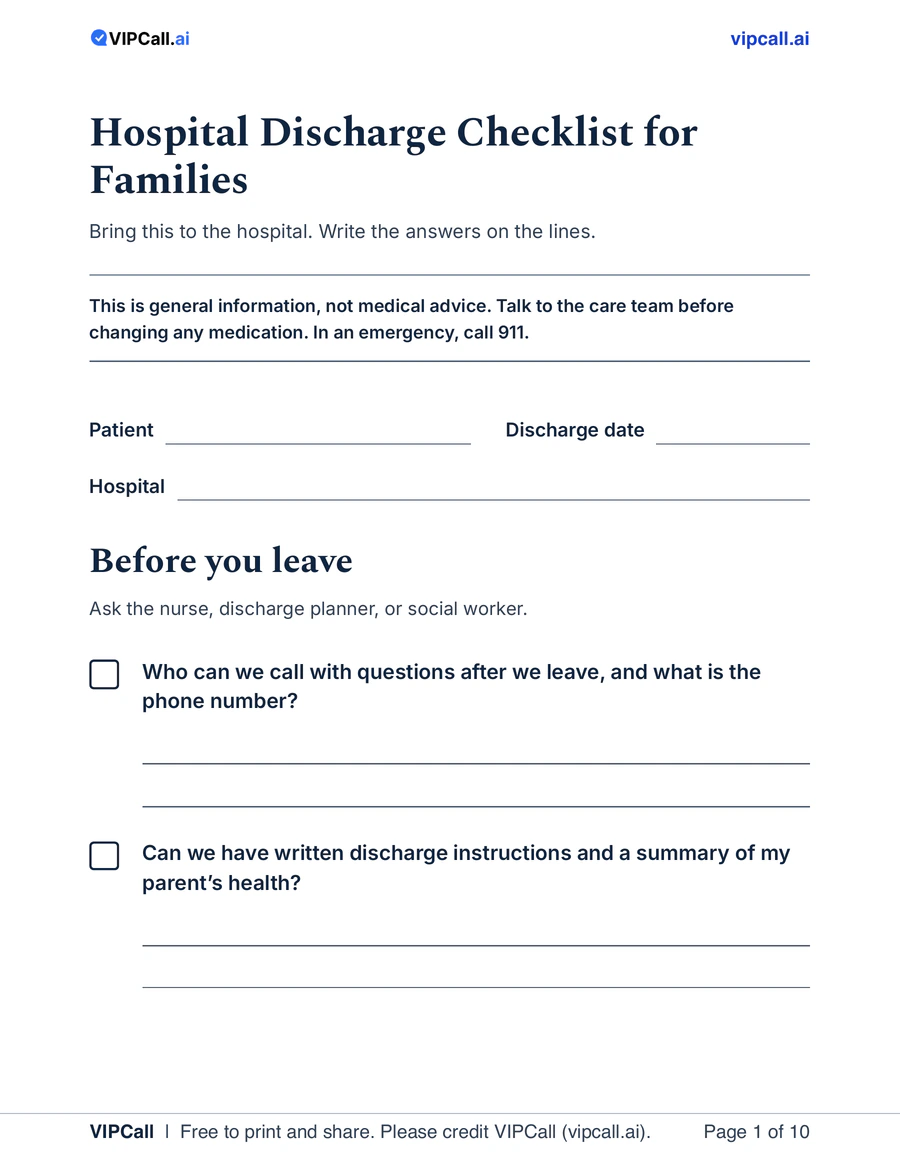
Before you leave
Ask the nurse, discharge planner, or social worker.
- Who can we call with questions after we leave, and what is the phone number?
- Can we have written discharge instructions and a summary of my parent’s health?
- Where will care continue: home, home health, rehab, or a nursing facility?Say what your parent prefers.
- Which new problems should we watch for, and what do we do about each one?
- Are any test results not back yet, and who will tell us?
- Which daily tasks will need help?Bathing, dressing, toileting, stairs, cooking, shopping, bills, rides.
- Can staff show us any special task and watch us practice it?Such as a bandage change or a shot.
- What will insurance cover, and what will we pay?Ask the social worker or health plan about help with costs.
- Does your parent need equipment, such as a walker?Ask if insurance covers it and who delivers it.
- If home health care is an option, how do we start it?Ask who will call you. Compare agencies at Medicare.gov/care-compare.
- Can we talk with the social worker about how our family is coping?Ask about support groups and resources.
Once these are answered, your family leaves with a plan in hand.
Medicines
Check every medicine against one list.
- Write down everything your parent takes, including what they took at home.Prescriptions, over-the-counter medicines, vitamins, and herbal supplements.
- Go through the list with the care team.Which continue, stop, are new, or changed?
- For each new medicine, ask what it is for and when to take it.Ask about side effects too.
- Ask the pharmacist if the new medicines are safe to take with the old ones.
- Get new prescriptions filled before the ride home, or plan the pharmacy stop.
- Share the updated list with every provider.Keep one copy at home and one in your parent’s wallet.
Do not stop or change a medicine without asking the care team. Keep the list on our free Medication List for Aging Parents.
With one clear list, every medicine has a plan.
Follow-up appointments
Write each visit here.
- Book follow-up visits before you leave, if you can.Primary care doctor and specialists.
- Ask who sends the hospital records to those doctors, and when.
- Plan rides, and choose who goes along to take notes.
| Appointment or doctor | Date | Time | Who is driving |
|---|---|---|---|
The PDF has 5 large rows to fill in by hand.
With visits booked and rides planned, the next step is set.
First 48 hours at home
One task at a time.
Set up the home
- Clear a safe path between the bed, bathroom, kitchen, and front door.
- Put these within reach: phone, charger, water, and easy food.Also papers, medicine list, and phone numbers.
- Stock any food the diet instructions call for.
Medicines at home
- Compare each pill bottle with the updated list.Set aside any medicine the care team stopped.
- Fill a weekly pill organizer from the updated list.
- Give medicines exactly as directed.If a dose is missed, ask the pharmacist. Never double up.
Check-ins
- Read the discharge instructions together and mark anything unclear.
- Write down how your parent is eating, drinking, sleeping, moving, and thinking.
| When | Who is checking in | Visit or call |
|---|---|---|
| Tonight | ||
| Tomorrow morning | ||
| Tomorrow night |
The PDF has 3 large rows to fill in by hand.
Your parent has a safe space, a clear plan, and people checking in.
First two weeks
A steady routine helps everyone.
Appointments and paperwork
- Bring the discharge papers, medicine list, and your notes to every follow-up visit.
- Write down what each doctor says.Update the medicine list the same day.
- Confirm that home health, therapy, and equipment have started.
- Keep hospital and insurance papers in one folder.Help with costs: shiphelp.org or the social worker.
Daily routine
- Check in every day, by visit or phone.Note appetite, sleep, pain, movement, mood, and medicines taken.
- Report changes to the care team right away.
- At the first refill, review the medicine list with the pharmacist.Ask whether every medicine is still needed.
Share the work
| Task | Who | By when |
|---|---|---|
The PDF has 3 large rows to fill in by hand.
- Keep one place where the whole family sees updates.
- Caregivers need rest too. Ask someone to cover a day.
Your family has a rhythm, and your parent has a team.
Who to call
Keep this page by the phone.
- Warning signs the care team told us to watch for
- Daytime number for questions
- After-hours number
- Symptoms the care team says need 911
In an emergency, call 911.
If your parent has Medicare
Hospital staff should give you the Important Message from Medicare. It explains how to ask for a fast appeal if you think your parent is being sent home too soon. An independent reviewer, called a BFCC-QIO, then looks at the decision. Call 1-800-MEDICARE (1-800-633-4227) for the BFCC-QIO that serves your state.
With the right numbers on one page, help is one call away.
How VIPCall can help after the paper is filled in
A checklist works best when someone follows up on it. VIPCall is an AI service that phones your parent on any phone, with no app to install, and gives your family one shared place to keep track of care.
Daily check-in calls
VIPCall phones your parent at the time you choose and texts the family a short summary. After a hospital stay, it gives everyone a steady way to hear how the day went. It does not replace a visit or a call to the care team.
Shared to-dos
Turn the lines on your checklist into to-dos. A to-do can be assigned to a family member, so the family can see who has taken it on.
Appointment follow-up
Add follow-up visits to a shared family calendar so rides and notes get planned ahead of the day.
Medication look-up
Add a medicine to your parent’s profile and VIPCall matches it to the federal RxNorm drug list, then shows a plain summary of what it is for from MedlinePlus. It also checks the medicines on the list against FDA recall notices.
Discharge papers in plain language
If you turn on the optional document reading setting, you can upload discharge papers and have an AI read and explain them. Confirm anything important with the care team.
VIPCall is not a medical provider and cannot tell you whether a medicine or a plan is right for your parent. The care team makes those decisions.
Also free to print
Keep the medicine list in one place with the free Medication List for Aging Parents.
Sources
This page puts guidance from the public sources below into plain language. VIPCall is not affiliated with these organizations, and no clinician has reviewed this page.
- Your discharge planning checklist (CMS Product No. 11376, December 2025) from Centers for Medicare & Medicaid Services. Questions to ask, medicine review, equipment, follow-up, caregiver tasks, and Medicare appeal rights.
- Taking multiple medicines safely from MedlinePlus, U.S. National Library of Medicine. Keeping a medicine list, sharing it with providers and pharmacists, and not stopping a medicine on your own.
- Keeping your medicines organized from MedlinePlus, U.S. National Library of Medicine. Pill organizers, what to record for each medicine, and missed doses.
- Medicine safety during your hospital stay from MedlinePlus, U.S. National Library of Medicine. Telling the care team about allergies and giving them a complete medicine list.
- Taking Care of Myself: A Guide for When I Leave the Hospital (AHRQ Publication No. 10-0059) from Agency for Healthcare Research and Quality. Further reading: a fill-in guide for tracking medicines, appointments, and phone numbers after a hospital stay.
Free to print and share. Please credit VIPCall (vipcall.ai). This is general information, not medical advice. Talk to the care team before changing any medication. In an emergency, call 911.