
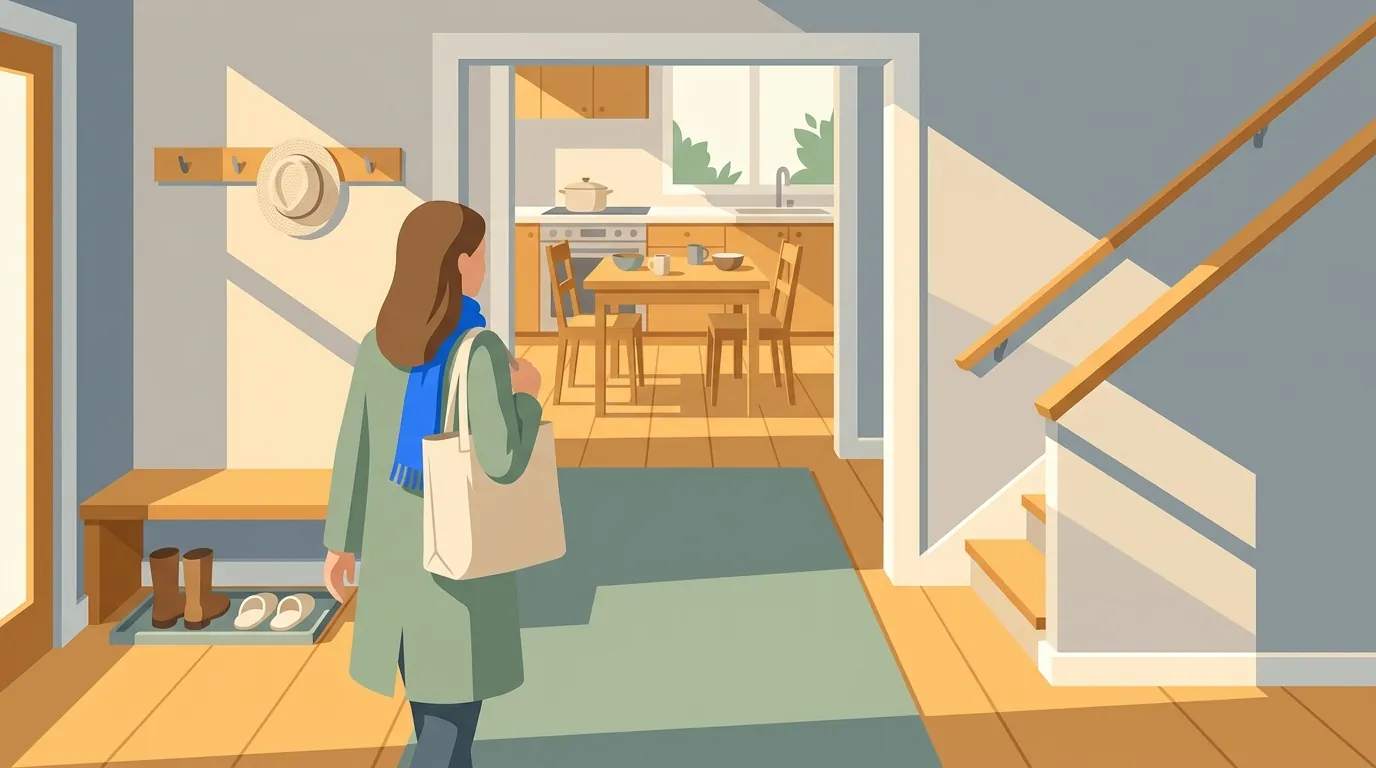
Use a holiday visit to walk through your aging parent's home room by room and notice what has changed. Look at the entrance and stairs, kitchen, bathroom, medicines, and mail, and at how your parent is doing. Write it down, talk about it kindly, and choose one or two next steps instead of fixing everything at once.
For many families, Thanksgiving or another holiday is the one time of the year they spend hours in a parent's home. A phone call can cover a lot, since the National Institute on Aging (NIA) notes that an older person might brighten up for a call or short visit, and that serious mood problems are harder to hide during an extended visit. This guide turns your visit into a calm walk-through. It does not diagnose anything, and one sign alone rarely means much. If you see several, read our post on signs your aging parent needs more help at home for next steps.
Before you start: how to look
NIA says the best way to know what someone needs is to ask them directly. Some people do not want to cause worry or admit they are struggling. Treat the walk-through as spending time at home together, not an inspection. Offer to help in the kitchen, take a lap through the house, and write things down privately afterward.
1. The entrance, steps, and walkways
Start at the front door. NIA says to go through the home room by room and first correct immediate dangers, such as loose stair railings and poor lighting.
- Are railings firm and the steps well lit?
- In winter, are the walkway and steps clear? NIA suggests ice melt or sand on icy areas by doors and walkways.
- Is the mail piling up?
If you see a hazard, fix it during the visit when you can. A bag of ice melt and a new bulb take minutes.
2. The kitchen and fridge
NIA suggests asking whether your parent can prepare meals on a stove safely, and whether the home is relatively clean and free of clutter. Open the fridge and the cupboards. Is there enough food your parent likes and can prepare?
If food is low, NIA suggests saying something like, "Mom, it looks like you don't have much food in the house. Are you having trouble getting to the store?" Then offer a specific fix, such as arranging groceries to be delivered on a regular basis. NIA also notes that significant weight gain or weight loss is a sign to raise with a doctor.
3. The bathroom
NIA asks whether your parent is bathing regularly and wearing appropriate clothing for the weather. In the bathroom, look at the floor of the tub or shower and the area by the toilet. NIA's home safety advice for people with Alzheimer's disease includes grab bars in the tub or shower, in a color that contrasts with the wall so they are easier to see, and nonskid strips or mats in the tub and shower.
4. The living room and bedroom
NIA says a simple accident, such as tripping on a rug or slipping on a wet floor, can change a person's life, and that more than one in four people age 65 or older fall each year. Walk the paths your parent takes between the bed, the bathroom, and the living room.
- Are there loose rugs or cords on the floor?
- Is there a nightlight on the path to the bathroom? NIA's home safety advice for Alzheimer's suggests nightlights or automatic light sensors.
- If your parent uses a cane or walker, is it the right size, and do the walker wheels roll smoothly?
- Is your parent wearing nonskid, rubber-soled, low-heeled shoes, rather than socks or smooth-soled slippers on stairs and floors?
Ask about any falls. NIA says to tell the doctor about a fall, even if it did not hurt. For more changes that help a parent stay at home, see our post on home modifications for an aging parent.
5. Where the medicines are
NIA lists whether your parent has the medications they need, and takes them regularly, among the changes to look at. Find where the medicines live. Is there a current list that shows the name, amount, and time, and the prescriber and the reason, for each one? NIA suggests keeping a copy at home and one in a wallet, and weekly pill boxes or timers can help.
If your parent has memory problems, NIA's home safety advice suggests keeping medicines and cleaning products in a locked area. Our post on medication management for elderly parents walks through a system the whole family can use.
6. The kitchen table: mail, bills, and phone
Sit down with the mail. NIA's list of early signs of Alzheimer's disease includes trouble with money and bills. Check for unopened envelopes, past-due notices, or the same bill paid twice, and treat them as questions to ask kindly, not as proof.
Ask about phone calls too. The FDIC advises people never to give bank account numbers, a Social Security number, PINs, or passwords unless they started the contact, and to walk away from anyone who says they must decide right now. Scam requests can come by unsolicited phone call, text, letter, or email. Our post on Medicare scam calls lists warning signs to share. List emergency numbers near each phone, as NIA suggests.
7. Your parent
Finally, look at your parent. NIA lists significant weight gain or loss, poor hygiene, confusion, falls, loneliness or social isolation, and trouble walking or getting around. It says occasional forgetfulness is a normal part of aging, but more significant memory problems, changes in thinking or personality, or poor decision-making could mean a condition that needs medical attention. Repeating questions and getting lost are among the signs NIA's list of mild-stage Alzheimer's describes.
Changes in mood count too. If your parent says they feel hopeless or you are worried they may harm themselves, NIA says to seek help right away: call or text the 24-hour 988 Suicide and Crisis Lifeline at 988.
What to do after the visit
NIA suggests this order.
- Write it down. Note what you saw, when, and which room. Share it with siblings so the picture is shared.
- Talk to your parent. Mention your worry without sounding critical and, as far as possible, follow their wishes. If they want to keep cooking at home, ask whether they would like groceries delivered.
- Offer something specific. A ride to an appointment, a groceries arrangement, or help with the medicine list is easier to accept than "you need more help."
- Suggest a visit to a health care provider if you are concerned about their physical or mental health. NIA says you can offer to make the appointment, drive, or go along.
- Look at services. Depending on the need, NIA lists a home health aide, transportation, or a geriatric care manager, and says you can share responsibilities with family, neighbors, and friends. The Eldercare Locator (1-800-677-1116) can help you find local services. NIA also offers a printable room-by-room home safety checklist and other worksheets for caregivers.
If you live far away, NIA suggests that, with your parent's permission, you ask neighbors, friends, doctors, or local relatives to call with any concerns. Our post on how to check on an aging parent from far away and the guide to how often to check on an elderly parent can help you plan.
How VIPCall helps after the holiday
The visit gives you a snapshot. Daily contact keeps you in touch afterward. VIPCall places a short daily phone call to your parent. It does not sell or require a device.
- Any phone. VIPCall calls a landline, flip phone, or smartphone. Your parent installs nothing, learns nothing new, and has no account. They answer a normal phone call.
- Short, natural calls. Each call is usually 1 to 5 minutes, adapts to how your parent responds, and remembers earlier calls.
- A text summary for you. After every call, you get a text message with the highlights.
- Your questions. Add your own, such as "Did you take your morning walk?" or a question about something you noticed during your visit.
VIPCall supports family communication and follow-through. It does not detect hazards at home, replace a visit, provide clinical care, or respond to emergencies. See how VIPCall works and compare family plans and pricing.
Sources and further reading
- National Institute on Aging, Does an Older Adult in Your Life Need Help?
- National Institute on Aging, Caregiver Worksheets
- National Institute on Aging, Aging in Place: Growing Older at Home
- National Institute on Aging, Home Safety and Alzheimer's Disease
- National Institute on Aging, Falls and Fractures in Older Adults: Causes and Prevention
- National Institute on Aging, What Are the Signs of Alzheimer's Disease?
- National Institute on Aging, Taking Medicines Safely as You Age
- FDIC Consumer News, Scams Targeting Older Adults
- Administration for Community Living, Eldercare Locator