
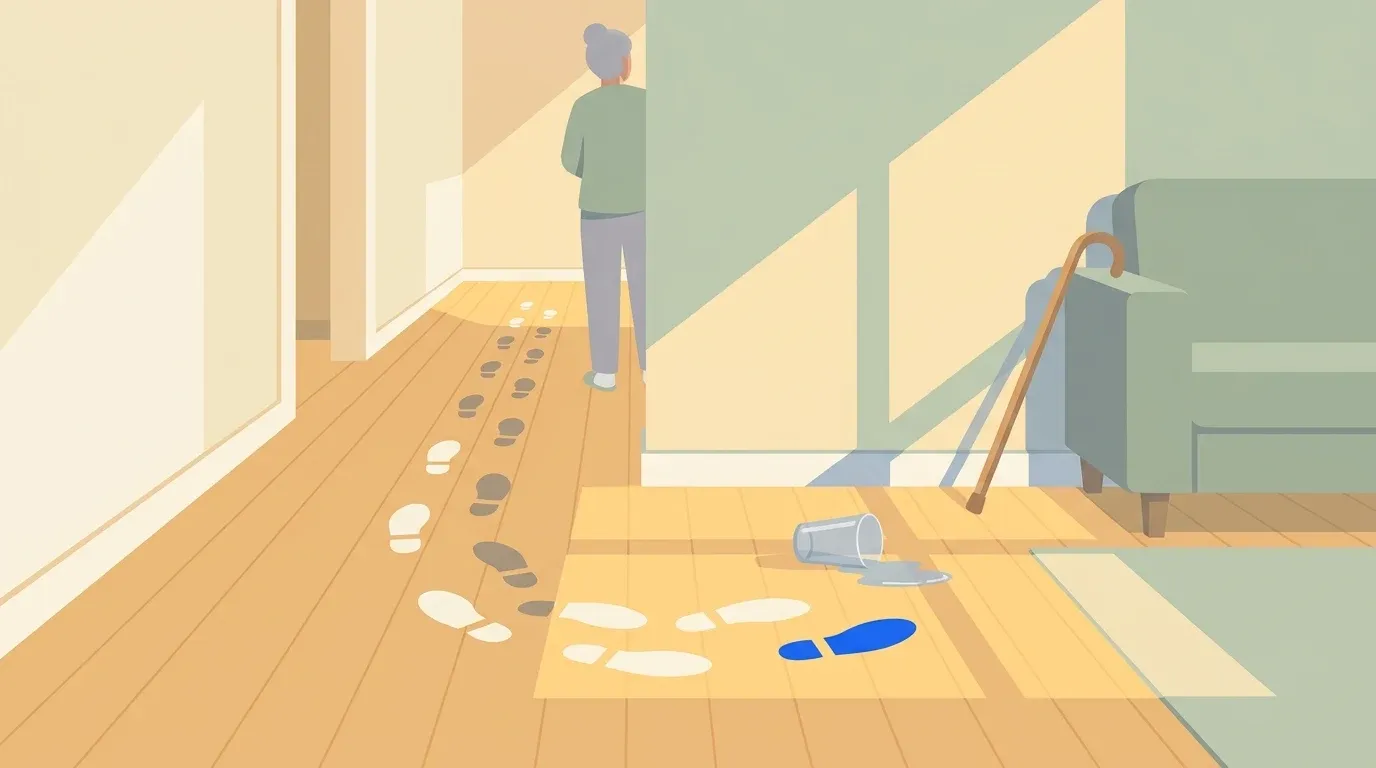
A senior's recovery is off track when new confusion, worsening pain, missed medicines, repeated falls, or a pattern of skipped meals shows up in the days after discharge, and families should treat any one of these as a reason to call the care team, not wait it out. Adult children who just brought a parent home from the hospital are often told what to watch for, then left to interpret ordinary bad days against a genuine downward turn. Knowing the difference is the whole job of the first two weeks home.
What recovery is off track actually looks like
Recovery is off track when the direction of change is wrong, not just when a day is hard. A parent who is tired but eating, talking normally, and sleeping through the night is likely on a normal healing curve. A parent who is more confused today than yesterday, who has stopped finishing meals, or who needs help with something they managed alone last week is showing a pattern that deserves a call to the doctor or discharge team. The Agency for Healthcare Research and Quality built its IDEAL discharge planning approach around five topics families should track after any hospital stay: life at home, medicines, warning signs, test results, and follow-up appointments. Watching for changes across those five areas, rather than guessing, gives adult children a concrete checklist instead of a vague sense that something feels off. This is also where a daily phone check-in earns its place, since VIPCall's daily call and family update turns a vague worry into a dated, specific pattern siblings can compare and act on together.
The medication problem nobody mentions at discharge
Hospitals hand over a new medication list, sometimes replacing every pill the person took before admission, and errors in that handoff are common enough that federal agencies track them nationally. The Centers for Medicare and Medicaid Services reported a 74.0% national average rate of medication reconciliation within 30 days of inpatient discharge among Medicare Advantage enrollees, meaning roughly a quarter of patients in that data did not have their medicines formally reconciled in that window. That gap is where duplicate doses, dropped prescriptions, and dangerous interactions happen. A sibling team should confirm, out loud, that the pharmacy list matches the discharge paperwork, and should ask the pharmacist or doctor to walk through every medicine using teach-back, the method AHRQ recommends for confirming the patient and family actually understood instructions rather than just nodded along. If a parent seems newly foggy, unsteady, or unusually sleepy, a medication issue should be the first thing ruled out.
Falls after discharge are a signal, not bad luck
A fall in the weeks after a hospital stay is rarely random. It usually points to a real change in strength, balance, medication side effects, or blood pressure that was missed at discharge. Recovery from a fall is possible for many older adults, particularly with fast evaluation and physical therapy, but the injury itself is only part of the risk. The bigger danger is what happens after: fractures, head injuries, a drop in confidence that leads to less movement, and a spiral of weakness from days spent sitting still out of fear. Any fall involving a head injury, an inability to bear weight, or new confusion needs same-day medical evaluation, not a wait-and-see approach. If a fall happens, families should ask directly whether it might be tied to a new medicine, a home hazard, or an infection, since treating only the bruise while ignoring the cause sets up the next fall.
Confusion and delirium deserve fast attention
New or worsening confusion after a hospital stay is one of the most serious signs that recovery is off track, and it is also one of the most treatable when caught early. The National Institute on Aging reports that the Hospital Elder Life Program, developed by Dr. Sharon Inouye, has reduced delirium incidence by 40% in hospitalized older adults through structured attention to orientation, hydration, sleep, and mobility. NIA also notes that delirium complications can include emergency visits and readmission within 30 days after discharge, which is exactly the window most families are watching closest. Confusion that appears suddenly, comes and goes through the day, or is paired with agitation or unusual drowsiness is not normal aging and is not something to monitor quietly at home. It needs a same-day call to the doctor, and if it is severe or sudden, it needs emergency evaluation.
When VIPCall or any check-in system is not enough
A daily phone call, an emergency button, or a check-in app can catch patterns and give families a consistent record of how someone sounds and what they report day to day. None of these tools can diagnose a medical problem, replace a nurse's hands-on assessment, or substitute for emergency care. If an older adult reports chest pain, sudden weakness on one side, a fall with a head injury, severe shortness of breath, or a level of confusion that seems dangerous, the right next step is always to call 911 or the person's physician immediately, not to wait for the next scheduled check-in. VIPCall and similar tools exist to surface the early, ambiguous signals and to keep a sibling team on the same page between visits and appointments. They are not a substitute for a treating clinician's judgment, and this article is not medical, legal, insurance, or financial advice. Any specific concern about a parent's condition, coverage, or care plan should go to their doctor, discharge team, or a licensed professional who knows the full picture.
What sibling teams should track together
Sibling caregiving falls apart most often not from lack of love but from lack of a shared, dated record. One sibling visits Tuesday and thinks Dad seems fine. Another calls Thursday and hears him slur a word and assumes it was nothing. Without a shared log, small signals get lost between people instead of adding up into a pattern anyone would recognize. A short daily note, whether from a phone call, a shared document, or a tool built for this, should capture appetite, mood, mobility, pain, and anything unusual. That is the same information a discharge planner would want to know if a follow-up call happens, and it is exactly the kind of caregiver update VIPCall's daily call is designed to produce and share with the whole family, without requiring the older adult to use an app or a smartphone.
Understanding the cost and coverage pressure behind the decision
Part of why families push a parent toward independence faster than may be safe is the cost structure of skilled care. Medicare generally requires a medically necessary inpatient hospital stay of at least three consecutive days before it will cover a skilled nursing facility stay, and Part A limits that SNF coverage to 100 days per benefit period. In 2026, days 1 through 20 cost $0 per day after the deductible, days 21 through 100 cost $217 per day, and the patient pays all costs after day 100. That cost curve means many families face real financial pressure to bring a parent home earlier than they feel ready for, which raises the stakes on catching an off-track recovery quickly at home rather than assuming a facility stay will absorb the risk. Understanding this tradeoff up front, alongside guidance in Questions to Ask Before Hospital Discharge and Home Health vs. Home Care After Discharge, helps families plan realistically instead of reactively.
What to do next
If a parent is recovering alone, start by reading Living Alone After Hospital Discharge for setup guidance specific to that situation. For every sibling team, the practical next step is the same: agree on who checks in daily, what counts as a red flag, and who calls the doctor when something changes. A consistent daily phone call, with a summary shared across the family, turns scattered impressions into a pattern anyone can act on quickly. See how VIPCall works for the people who matter most at vipcall.ai, and build the daily habit that catches a recovery going off track before it becomes an emergency.